Error on the module:
Top Tips: Photographing Architecture
Subject Matter
Whether you are travelling the world or staying closer to home, architecture presents a fascinating subject matter for photographers. From old historic stone buildings to modern glass and steel, each building is unique, and there are many ways to photograph them.
Those wanting a detailed archive shot may opt for a wide view, with perfectly straight lines and high resolution to capture all the detail. Others may opt for a more abstract shot by focusing on a particular detail or how the building merges with its surroundings. However, wherever you want to shoot architecture, many features on Sony cameras and lenses will help you to get the shot.
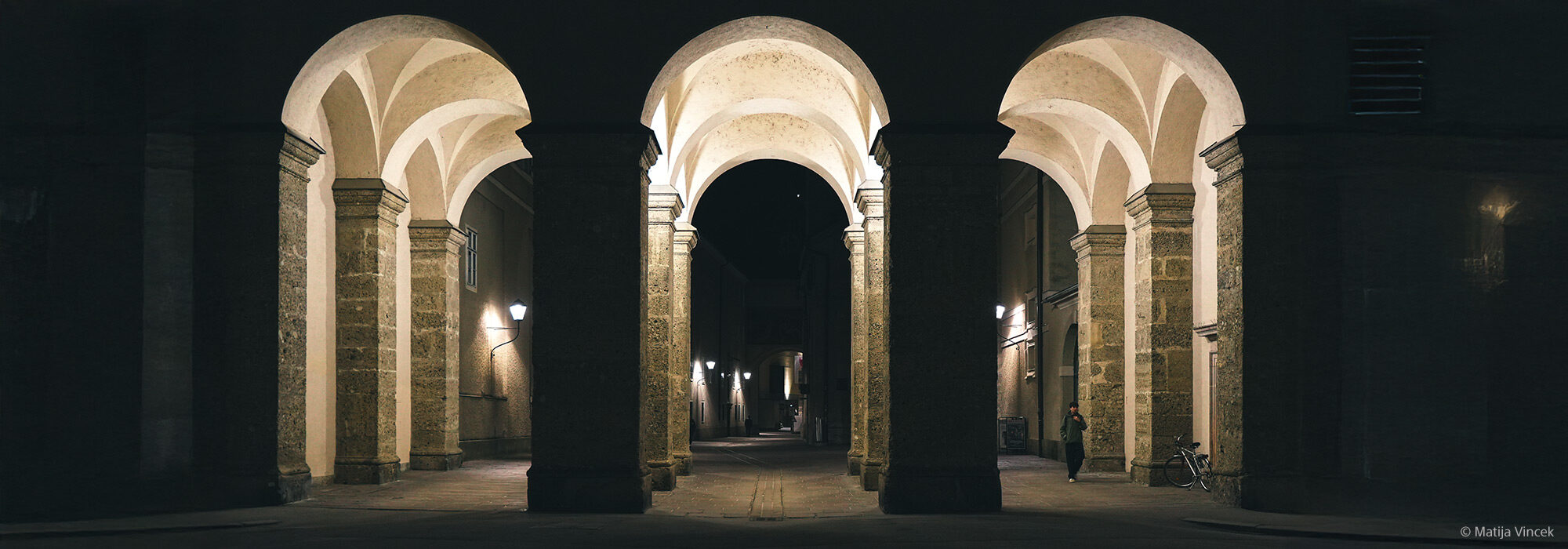
And don’t forget that buildings can look very different depending on the time of day. Colour, light, and shadows can all change through the golden glow of sunrise to the illuminated facades and windows at night.
Perspective
One thing that is difficult to avoid is perspective. As you tilt your camera up, vertical lines will converge. To help minimise this, keep your camera level by using the built-in Level Display and move backwards to get everything in shot. With a high-resolution sensor, you can always crop your image afterwards to remove any unwanted foreground.
If you have no choice but to tilt your lens up, then take a few steps back and leave some space around the building. This will enable you to adjust the perspective in the software during editing.
Details
Buildings can be full of details that can get lost when viewed as a whole. Different materials, colours, reflections, or the way light hits a particular spot can all make for great abstract shots that showcase the character of a building. Use a short telephoto lens, such as the Sony FE 100mm f/2.8 Macro GM OSS or the FE 70-200mm f/2.8 GM OSS II, to capture some of the details that help make the building what it is.
Lens Choice
When it comes to architecture, straight lines are everything. That is why it is best to use Sony wide-angle lenses, which have low distortion and excellent image quality, even in the corners. This can be further enhanced by using the automatic in-camera Lens Distortion correction that can be found in Shooting > Image Quality > Lens Compensation. Ensuring that Shading Compensation, Chromatic Aberration Compensation, and Distortion Compensation are all enabled will yield the best image quality for each genuine Sony lens you use.
For architecture, particularly in towns and cities, you will usually want a wide-angle lens to get everything in shot. Sony has an elite range of wide-angle lenses from the FE 12-24mm f/2.8 GM and the FE 16-35mm f/2.8 GM II zoom lenses to the exceptional FE 14mm F/1.8 GM and affordable FE 20mm f/1.8 G lens. There is a range of different options. And those with APS-C sensor cameras can opt for the light and compact E PZ 10-20mm f/4 G lens—a great camera and lens setup for your city travels.
Pixel Shift Multi-Shooting
Some Sony Alpha cameras, such as the Sony Alpha 7R V and Sony Alpha 1, have Pixel Shift Multi Shooting. This feature utilises sensor stabilisation to move the sensor in tiny increments while taking a series of 4 or 16 images. The images can then be merged in Sony’s Imaging Edge Desktop software to create an image with a resolution of up to 240 megapixels (in the case of the Alpha 7R V). This is perfect, getting an incredible amount of detail and texture.
You can find Pixel Shift Multi Shoot. In the Shooting>Drive Mode menu. Switch it to On and then choose the time between each shot. It is essential to use a sturdy tripod to keep the camera perfectly still and prevent any moving elements, such as people or cars, from appearing in the image.
Foreground Interest
It is easy to take the classic postcard image of a famous building: wait for the scene to clear, hold the camera at eye level, and take the shot. Instead, use the articulated screen of your Sony camera to get down low to the ground - a puddle, wet surface, or shiny object can help create an interesting reflective foreground. Or look for a way to frame the building using something in the foreground that can be out of focus, such as a plant, tree, or street furniture. These other elements can add a sense of scale and location to the image, as well as provide context for its location.
Interior Shots
Many buildings are as famous for their interiors as they are for their exteriors, so don’t forget to go inside to see what is on offer. Symmetry typically provides the standard shot for the interiors of castles, churches, and cathedrals, and many buildings feature famous spiral staircases. However, you will almost undoubtedly not be allowed to use your tripod, so make sure to take advantage of the low noise of Sony sensors, increase your ISO sensitivity, and ensure that SteadyShot is enabled on both your camera and lens to keep your images free from camera shake. If the light levels are really low, lean against a wall or wear a backpack on your chest and use a makeshift camera support. And don’t forget to switch to Silent Shooting if it is appropriate to be respectful.
Summary
- Subject Matter: Architecture offers endless photographic possibilities from archival documentation to abstract compositions.
- Perspective: Keep your camera level using the Level Display and step back to minimise converging verticals.
- Details: Use telephoto lenses, such as the FE 100mm f/2.8 Macro GM OSS or FE 70-200mm f/2.8 GM OSS II, to capture abstract architectural details.
- Lens Choice: Utilise Sony's low-distortion wide-angle lenses and enable all Lens Compensation settings to achieve straight lines.
- Pixel Shift Multi Shooting: Create ultra-high 240MP images using a tripod and the Sony Alpha 1 II or Alpha 7R V
- Foreground Interest: Get low to capture reflections or frame buildings through foreground elements for added interest.
- Interior Shots: Enable SteadyShot and raise ISO for handheld shooting in low-light interiors where tripods aren't allowed.
